Study on the actual land footprint of wind farms
Thursday, 12 March 2026
How much land do wind farms really occupy – and what does this mean for the environment?
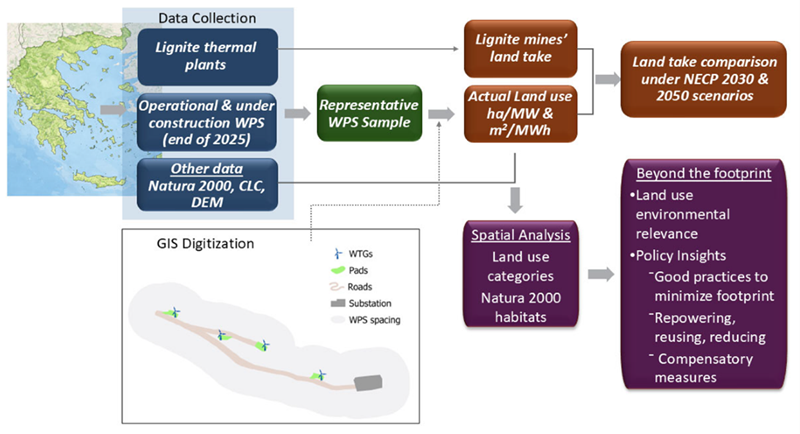
This is the question addressed by the scientific study “Beyond the Footprint: Empirical Land Use and Environmental Patterns of Wind Energy in Mountainous Landscapes”, published in the international journal Land (MDPI) by members of the Hellenic Wind Energy Association (ELETAEN). The research was based on the analysis of real-work data from wind projects in Greece, with a total installed capacity of approximately 2.6 GW.
Researchers utilized digital GIS tools to study the actual infrastructure of wind farms – such as access roads, turbine installation sites, substations, and interconnection lines – in order to measure the true extent of the land they occupy.
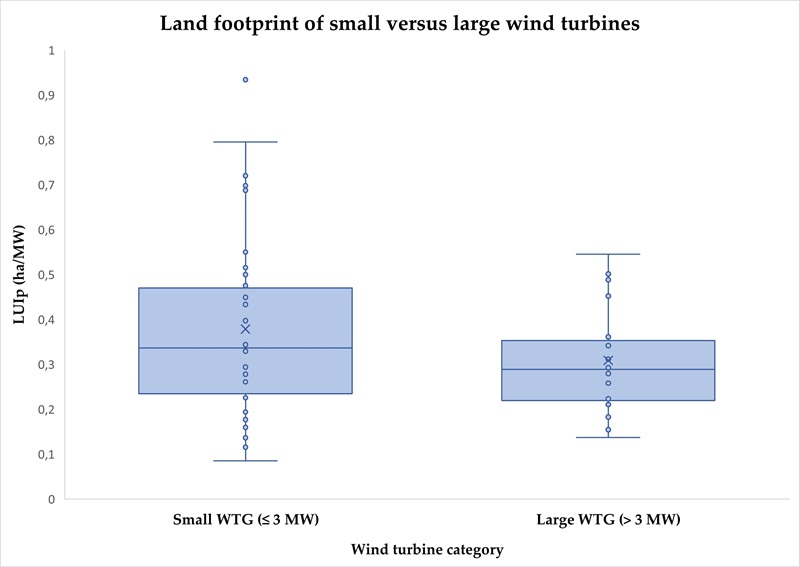
The study’s key finding is that the average land footprint of the infrastructure amounts to 0,33 hectares per MW. This value falls within the lower range of values reported in international literature for wind projects. For the subset of projects where energy production data were available, the land footprint corresponds to just 1,58 m2 per MWh produced.
The study also demonstrates that wind farms using newer, higher-capacity turbines (>3 MW) have a smaller land footprint per MW compared to projects using older, lower-capacity turbines (<3 MW). This finding highlights the importance of repowering, the process of replacing old turbines with fewer, more powerful ones, to further reduce the land occupation of wind farms. Additionally, the researchers explored best practices in designing new projects to minimize their spatial footprint (sharing infrastructure between neighboring wind stations, using blade lifter vehicles for transporting blades etc).
Based on the research results, even if the targets of the National Energy and Climate Plan (NECP) for wind energy by 2050 are met, it is estimated that all the country’s wind infrastructure – Including auxiliary works – will occupy just 0,02–0,03% of Greece’s total land area.
For comparison, lignite mining has already transformed approximately 0.13% of Greek territory, nearly four times the area estimated for all wind projects combined, even under the long-term energy scenario.
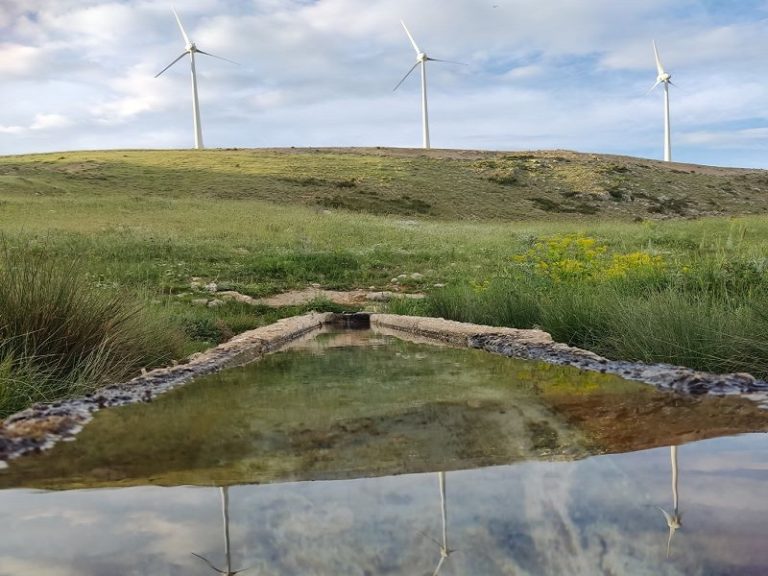
The study also emphasize that the concept of “land occupation” should refer to the actual infrastructure of wind projects. The space between the wind turbines remains open and continues to be used for other activities, such as livestock grazing, agriculture, or beekeeping.
At the same time, the study points out that land occupation alone is not a sufficient indicator of environmental impact. The real effect depends heavily on the ecological value of the area, the quality of the ecosystem, and the way the project is designed.
Consequently, this indicator alone does not constitute a proper basis for the approval or rejection of a project during its licensing process. If land occupation is considered as cost, then the argument must be part of a broader cost-benefit analysis, which examines alternative options – Including the non-implementation of the project (zero-alternative solution) – and explicitly compares the land requirements of all available energy production technologies, both conventional and renewable.
Finally, the environmental assessment of wind projects must also consider the restoration and compensatory measures that accompany them, such as landscaping restorations, reforestation of an equal area they occupy, or equivalent forestry works (such as forest road maintenance, firebreaks, forest protection projects, etc.).
You may find the full study HERE